Built to Get Better With Age: Craft, Patina and the Details That Define a RESLU Home
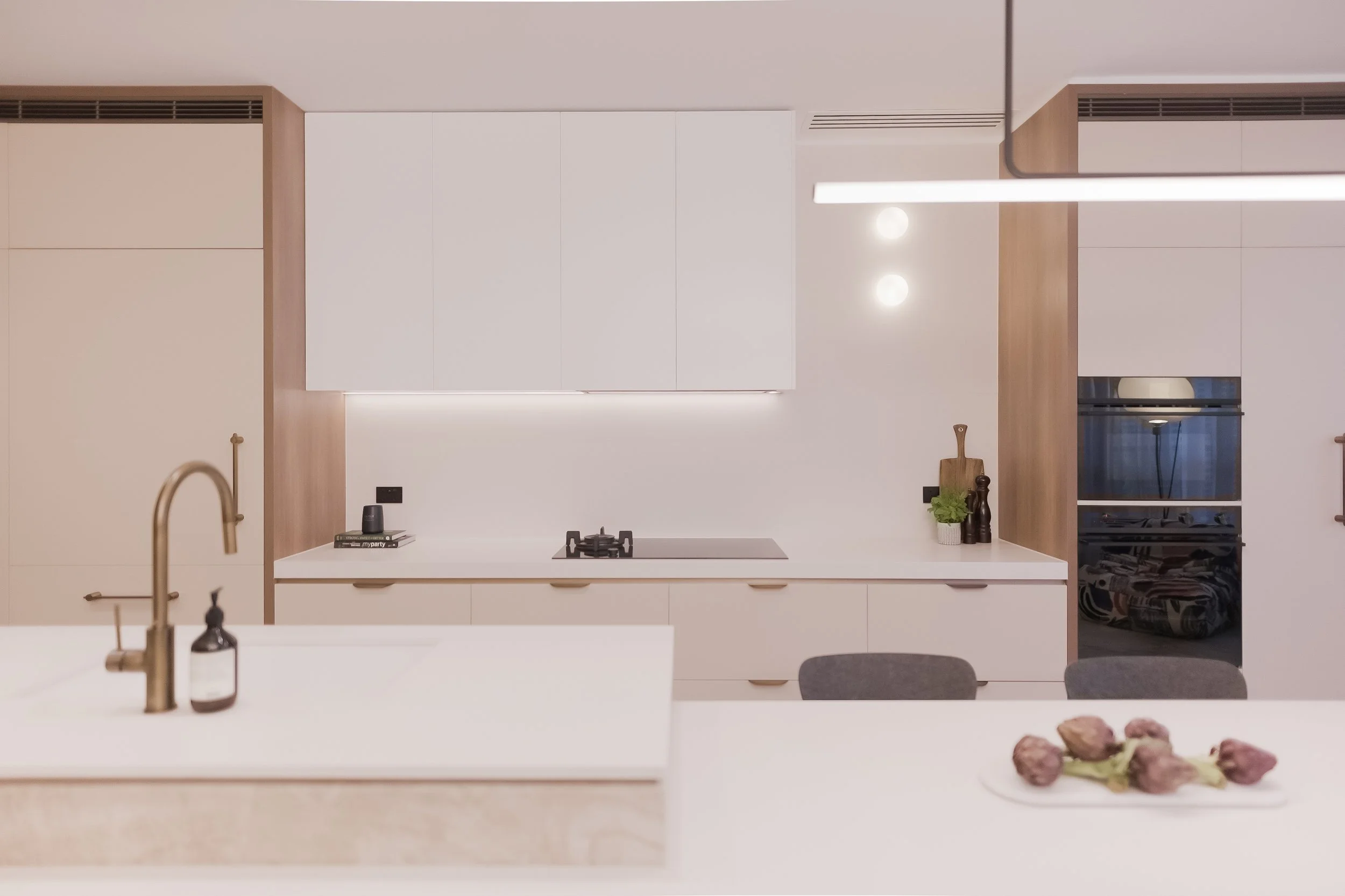
There is a tendency in residential building to focus on the big picture.
The kitchen. The stone. The size of the extension. The photograph at the end.
At RESLU, we tend to look at residential design and construction in Adelaide from the opposite direction.
We believe the bigger picture is created by hundreds of smaller decisions: the material chosen for a door handle, the junction between two finishes, the thickness of an edge, the way a skirting meets a doorway, or whether a hinge has been properly removed before something is painted.
Individually, none of these decisions defines a home.
Together, they do.
The little one percenters
You have probably walked through a house that looks beautiful from across the room, but starts to unravel when you get closer.
Paint across hinges. Poorly aligned cabinetry. Silicone trying to resolve a junction that should have been detailed properly. An expensive stone benchtop sitting beside inexpensive finishes chosen primarily to recreate the appearance of something more substantial.
These things can seem insignificant during construction.
We do not think they are.
Good detailing requires somebody to care enough to stop, think and sometimes take the slower path. It requires craftspeople who understand that the work is not finished simply because it technically functions.
That extra attention might represent one percent of the project here and another one percent somewhere else.
But once those decisions are layered together, they become the architecture.

Houses should not be fast fashion
Increasingly, we see homes being treated a little like fast fashion.
Natural materials are replaced with printed reproductions. Solid materials become veneers. Metal finishes become coatings designed to resemble something else. Products are selected because they can create an immediate impression rather than because of how they will perform over the next twenty years.
In some ways, we are creating knockoffs of our own homes.
There is nothing inherently wrong with economical materials. Every project requires decisions about where money should and should not be spent.
But there is a distinction between looking expensive and being well made.
A marble benchtop alone does not make a house luxurious.
For us, luxury is much quieter than that.
It is a door that still closes beautifully years later. A material that develops character rather than simply deteriorating. Joinery that has been properly resolved. Hardware that feels substantial in your hand. Details that perhaps nobody notices consciously because they simply feel right.
We like materials that age
One of the principles that guides a lot of our work is patina.
We do not necessarily want a house to look untouched forever.
We like natural stone that changes subtly with use. Metals that oxidise and deepen. Timber that becomes richer. Materials that record some evidence of the life happening around them.
Often, these materials cost more initially.
But we think there is value in looking beyond the handover date.
A material that becomes more beautiful as it ages does not need to be continually replaced to make a house feel new again. There is less pressure to renovate simply because a finish has fallen out of fashion.
The objective is not perfection.
It is permanence.
Where the money goes
For the kind of whole home renovations in Adelaide and home extensions in Adelaide we undertake, projects that allow this level of design, materiality and construction finesse will often sit somewhere around $750,000 to $1.5 million, depending on the scale of the work.
That does not mean spending money indiscriminately.
Quite the opposite.
Part of good design is understanding where an investment will genuinely change the experience or longevity of a home, and where it will not.
Sometimes the right decision is an expensive one.
Sometimes it is an incredibly simple one.
What matters is that it has been considered.
These are not generally homes conceived to be renovated quickly and sold again. They are projects for people who intend to live in them, use them, mark them and watch them change over time.
That changes the conversation.
Instead of asking only what something will look like when construction finishes, we can ask what it will look like in five years.
Or fifteen.
Craft before spectacle
We are not particularly interested in adding detail simply for the sake of detail.
In fact, much of our work is deliberately restrained.
The finesse comes from proportion, junctions, material changes, craftsmanship and consistency.
Sometimes the best detail is the one that almost disappears.
At West Lakes Shore, for example, much of the result came from decisions that are easy to overlook in isolation. Opening the original fireplace to frame the ocean view and concealing the remaining nib within the cabinetry allowed several elements of the house to read as one composition.
That requires close collaboration between designer, builder and trades throughout construction. Drawings are important, but so are the decisions made when standing on site looking at something at full scale.
Building well is not simply about assembling a collection of beautiful products.
It is about how those products meet.
It is about how they are installed.
And it is about whether somebody cared enough to get the last five millimetres right.
“The person who does it cheaper and quicker often pays for it twice.”
We would rather build something once and give it the opportunity to become better with age.
We’d love to hear about what you’ve got planned.
Enquire about your project →